Thinking about AI

Over the past few weeks, I’ve been dabbling my way through this pretty mess of building with tools like Manus.ai, Vercel, Cursor, ChatGPT, and Claude (vibe coding, as some people distastefully call it). Here are a few thoughts I’ve had about how AI is reshaping the way we create.
The Internet helped us scale information and ideas but with AI, we’re now scaling intelligence itself. And when you start seeing it that way, the pace at which everything changes suddenly makes a lot more sense. It’s shifting the landscape, becoming an equalizer, giving everyone the same foundational access to scalable, powerful technologies.
LLMs are bringing you closer to the machine. You can now talk directly in natural language, but clarity still matters. You need to delegate well and explain your vision clearly. We’ve evolved from Assembly → High-Level Languages, and now we’re adding one more abstraction layer. Prompting is your new programming language, and LLM are your compilers, which are translating human ideas into actionable instructions.
The bar for “good enough” is rising, because anyone can prompt their way to a workable prototype. But the real advantage goes to system thinkers. These are the people who naturally dissect big problems into modular pieces, spin up feedback loops, and orchestrate the architecture efficiently. AI thrives on this orchestration: modular tasks, finely tuned agents, feedback loops and well written prompts.
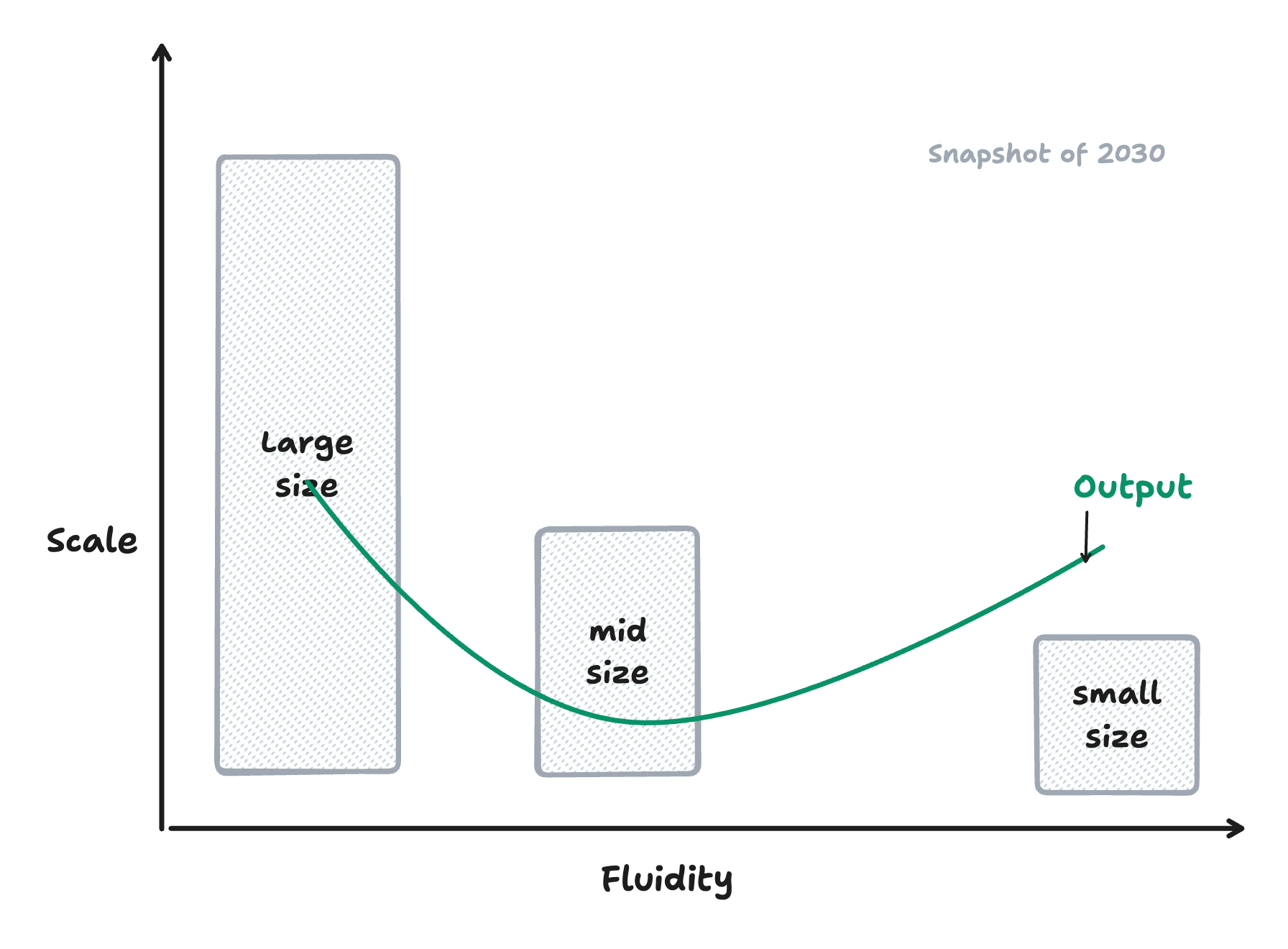
What really matters now isn’t size, it’s Fluidity. Think of Fluidity as a function of Velocity and Adaptability i.e. Fluidity = f(Velocity, Adaptability). It’s how fast you can plug in, iterate, and keep momentum flowing. Modularity makes this possible. It lets people jump in, contribute, and align without friction. These traits used to be nice-to-haves; now they’re core advantages if you want to build something real and stay relevant.
Setups with fewer layers, more ownership, and faster decisions unlock serious momentum with AI. Look at what Cursor, Midjourney, Loveable, Perplexity and Windsurf are doing. They’ve moved fast, built smart, stayed focused. And they’ve scaled impressively, some into billion-dollar territory in what feels like no time, with very lean teams. A few years back, that would’ve sounded like an outlier. Now? It feels like The Blueprint.
You can’t approach this advancement in the old-school way, carefully and predictably. This isn’t just another tool; it’s a shift in how we think, how we build, how we move. The change isn’t linear, it’s more exponential than ever. Ideas still offer leverage, and scale does too. But velocity on its own isn’t enough, it’s Fluidity that truly matters now.
How smaller team sizes might have an unfair advantage